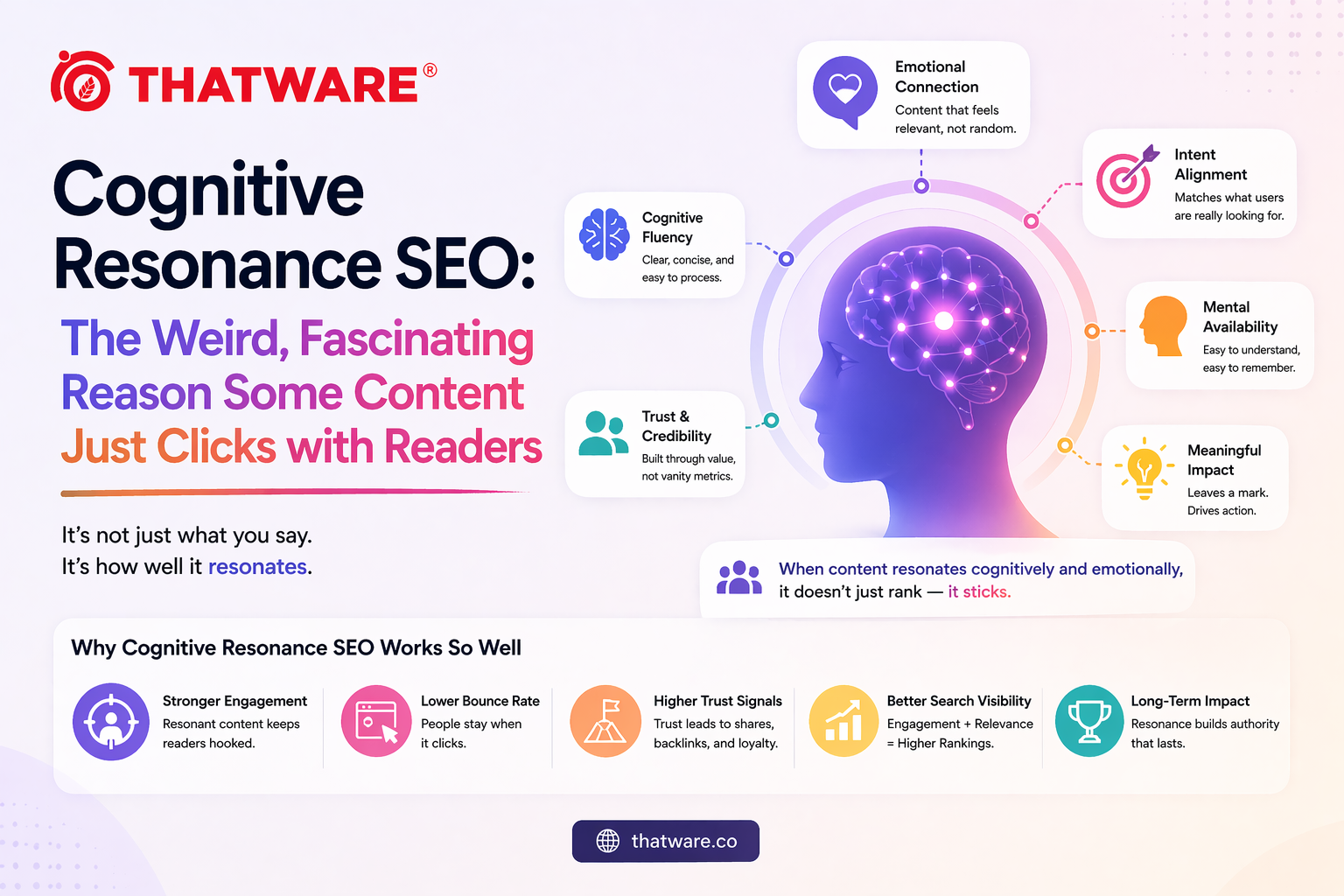
There’s a type of content that does something unusual. You start reading it and something just… lands. Not because it’s written better than everything else. Not because it has more information. But because it seems to understand where you are and what you need in a way that feels almost personal. You share it. You bookmark it. You remember the brand behind it.
That’s not an accident. It’s not even always intentional. But there’s a framework for understanding why it happens – and how to replicate it deliberately.
What Cognitive Resonance Means
Cognitive resonance, borrowed from psychology, refers to the alignment between the way information is presented and the cognitive state of the person receiving it. When a presentation matches a mental model, the information doesn’t just transfer – it integrates. It feels right rather than just being understood.
In content terms, this means matching not just the informational content of what you’re writing to the reader’s needs, but the structure, framing, pacing, and emotional register of it to the mental state they’re in when they encounter it.
A reader who’s just starting to research a problem needs different framing than someone who’s already evaluated three options and is close to a decision. A person in a moment of frustration needs a different tone than someone who’s calmly planning. Content that recognizes where someone is and meets them there resonates. Content that ignores this feels generic, even if it’s technically accurate.
Why This Matters for Search and SEO
Search engines have been getting better at detecting engagement signals. Time on page, scroll depth, return visits, shares, branded search increases after content exposure – these things matter for ranking. But they’re downstream of a more fundamental question: does your content actually resonate with the people who find it?
crseo services – cognitive resonance SEO – sit at the intersection of behavioral psychology, content strategy, and search optimization. They approach content from the question of how to create material that genuinely lands with readers at a psychological level, and then build the technical SEO structure around content that’s earned the right to rank.
It’s not a magic formula. But it’s a more honest way of thinking about what makes content valuable than most SEO frameworks acknowledge.
The Elements of Resonant Content
Some of this is structural. Research on cognitive load suggests that content with clear visual hierarchy, appropriate chunking, and consistent pacing is easier to process. Easier to process means more likely to be read to completion. More likely to be read to completion means better engagement signals.
Some of it is about framing. Starting a piece of content from the reader’s problem rather than the brand’s solution is consistently more resonant. It sounds obvious but most corporate content does the opposite – it starts with what the company does and then explains how that relates to the reader’s problem. Reversing that sequence changes the entire emotional register of the content.
Some of it is about intellectual honesty. Readers can tell when content is trying to manipulate them versus genuinely trying to help them. Content that acknowledges tradeoffs, admits uncertainty where uncertainty exists, and gives readers information they need rather than information that flatters the brand builds a different kind of trust.
The SEO Connection
Here’s where cognitive resonance connects directly to search performance. Google’s evaluation systems – especially with the integration of AI-based quality assessments – are increasingly good at detecting the quality signals that correlate with genuine reader satisfaction. Engagement behavior, return visits, brand search lift, content sharing patterns – these all feed back into how content is evaluated.
Content that resonates with readers produces those signals naturally. Content that’s optimized for technical signals without genuine resonance tends to produce the opposite – visitors who bounce quickly, don’t engage, don’t return. Over time, that pattern depresses rankings.
cognitive seo services are built on the premise that the best path to sustainable search performance is building content that genuinely satisfies readers – and then making sure that content is technically well-structured so search engines can find, index, and evaluate it properly. The technical and the human are not in tension here. They’re aligned.
Measuring Resonance
One challenge with cognitive resonance as a concept is that it’s harder to measure than keyword rankings. But there are meaningful proxies. Time on page versus industry benchmarks. Scroll depth. Return visitor rates. Social sharing per visitor. Branded search volume trends correlated with content publishing.
A content audit that looks at these signals alongside traditional SEO metrics can reveal a lot. Usually, the pages with the best resonance metrics are also the pages with the strongest long-term ranking stability. The correlation isn’t perfect but it’s consistent enough to be actionable.
The Bigger Picture
There’s something worth sitting with here. The reason cognitive resonance matters for SEO is ultimately the same reason it matters for any communication: people remember, trust, and act on information that genuinely connects with them. That hasn’t changed because AI can now generate text at scale. If anything, it’s become more important – because in a world full of generated content, the bar for resonance is set by human expression that feels real.
Content that actually clicks with readers is a competitive advantage that’s hard to copy. That’s a good enough reason to take it seriously.